

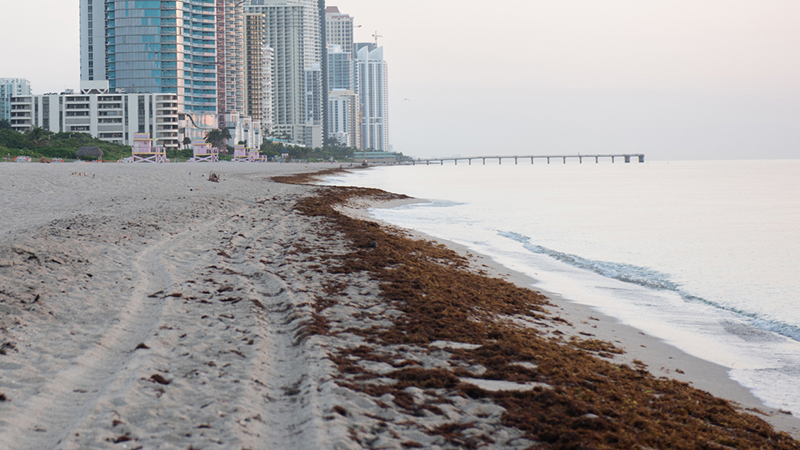
Sargassum, also often referred to as seaweed, is a naturally occurring seaweed that floats freely on the ocean surface and is abundant in the Atlantic Ocean and the Gulf of Mexico. It provides crucial habitat for many marine species, including endangered sea turtles, which, upon hatching on our beaches, make their way out to the sargassum to spend their juvenile years feeding and growing amongst the seaweed mats. It is also an important element in shoreline stability. Sargassum also provides nutrients to the shoreline and can replenish areas that suffer beach erosion due to hurricanes and storms, thereby helping to keep our shorelines resilient.
Over the past several years, South Florida and the Caribbean have experienced high levels of sargassum in coastal waters and on local beaches. Excessive amounts of sargassum in populated areas are causing concern worldwide.
Maintaining our beautiful beaches remains a priority for Miami-Dade County Parks, Recreation and Open Spaces Department. Clean-up crews operate on a daily basis to remove the buildup of seaweed on the water line. Below are frequently asked questions on sargassum, for your information.
When is seaweed season?
Seaweed season is March through October.
Where does seaweed come from?
It comes from the largest bloom of macroalgae in the world, the Great Atlantic Sargassum Belt (GASB), which blankets the surface of the tropical Atlantic Ocean from the west coast of Africa to the Gulf of Mexico. Impacts of warmer water temperatures and nutrient availability both from human-derived (deforestation and fertilizer) and natural sources (upwelling of deep-water nutrients to the surface) also cause the accumulation of sargassum.
Why is it appearing along our beaches?
Sargassum has flourished in recent years due to the combination of an increase in nutrient runoff from the Amazon River, upwelling off the western coast of Africa and changing water temperatures. In 2011, the seaweed mats grew to form a 5,550-mile-long belt that extended from West Africa to the Caribbean Sea and Gulf of Mexico. Winds and currents then push the seaweed ashore.
Coastal areas worldwide experience two tides every day. Miami-Dade Parks’ beach operations crews tackle seaweed early in the morning, prior to beach goers arriving at the beach.
Unfortunately, when the second tide arrives in the afternoon, depending on the winds, it often brings another wave of seaweed to the shoreline.
Will Sargassum ever go away?
Although the abundance of seaweed conditions are expected to improve around October or November, the great Atlantic sargassum belt may be the “new norm,” according to a recent report by the American Association for the Advancement of Science. This means Sargassum may become a regular sight on South Florida beaches during “Sargassum Season” (March through October).
Is it harmful to beachgoers?
According to the Florida Health Department, as sargassum decomposes, it gives off a substance called hydrogen sulfide. Hydrogen sulfide has a very unpleasant odor, like rotten eggs. Although the seaweed itself cannot harm people, tiny sea creatures that live in sargassum can cause skin rashes and blisters. Hydrogen sulfide can also irritate the eyes, nose and throat. If you have asthma or other breathing illnesses, you’ll be more sensitive to these symptoms. However, the levels of hydrogen sulfide in an area like the beach, with large amounts of airflow, are not expected to harm health.
What is the process of managing seaweed along the beach? Does it require special permits?
During sea turtle nesting season (May through October), the use of heavy equipment to manage seaweed on the beach is only allowed by special permit. Parks works closely with the State of Florida Department of Environmental Protection (FDEP) and the Florida Fish and Wildlife Conservation Commission (FWC) to secure the required beach cleaning permits. Every morning, prior to operating heavy machinery on the beach, the Miami Dade County Parks’ Sea Turtle team survey for sea turtle nests and mark them for their protection. Once the survey is complete, beach operations team proceed to clean the beach.
Miami-Dade Parks implements an adaptive management strategy to manage seaweed along the beach. The Miami-Dade County Parks’ Beach Operations team cut and turn the seaweed along the shoreline throughout the 17 miles of county coastline, from Government Cut to the Broward County line, and Crandon Park beach. Additional collections are done in areas where there is heavy seaweed buildup, i.e., along breakwaters and jetties, Miami-Dade Parks applies for a state permit to allow for the removal of sargassum by a Miami-Dade County contractor. These areas are:
- North of Haulover Cut
- South of Haulover Cut
- 22nd Street through 32nd Street in Miami Beach
- North of Government Cut jetty
Coastal areas worldwide experience two tides every day. Miami-Dade Parks’ beach operations crews tackle seaweed early in the morning, prior to beach goers arriving at the beach.
Unfortunately, when the second tide arrives in the afternoon, depending on the winds, it often brings another wave of seaweed to the shoreline.
Why can’t seaweed be removed from the water before it reaches the shoreline?
State and federal environmental regulations prohibit the removal of seaweed from the water prior to its landing on the shore. The water is under the jurisdiction of the state through DERM (Department of Environmental Resource Management).
According to the South Atlantic Fishery Management Council, “The Sargassum Fishery Management Plan (FMP) applies to the Sargassum resources of the South Atlantic Region. The original FMP was approved in 2003. The Sargassum FMP was developed to impose strong limitations on the commercial harvest of Sargassum. The FMP prohibited the harvest of Sargassum south of the NC/SC state boundary, implemented a total allowable catch of 5,000 pounds (wet weight) per year, limited harvest to November through June to protect turtles, required observers onboard any vessel harvesting Sargassum, prohibited harvest within 100 miles of shore, and implemented harvesting gear specifications.”
Where does the removed seaweed end up?
The excess seaweed that is removed from specific areas of the beach under a special state permit is transported to a landfill.
Originally published at https://www.miamidade.gov/global/news-item.page?Mduid_news=news1612480690815524